A shared kitchen works better when ownership, common supplies and refill responsibilities are clear. Give each person a manageable area, reserve a separate group for shared items and agree on how the arrangement will be maintained.
Agree on the categories first
Decide which ingredients are personal and which are shared. A shelf full of identical unlabelled jars can create more confusion than the original packets. Use names or agreed household labels where needed and preserve ingredient information when decanting.
Avoid assuming that everyone wants to share food, utensils or cleaning products. Establish the rules directly, especially where personal dietary needs require separation. A storage layout should support the agreement rather than substitute for it.
Allocate space by access
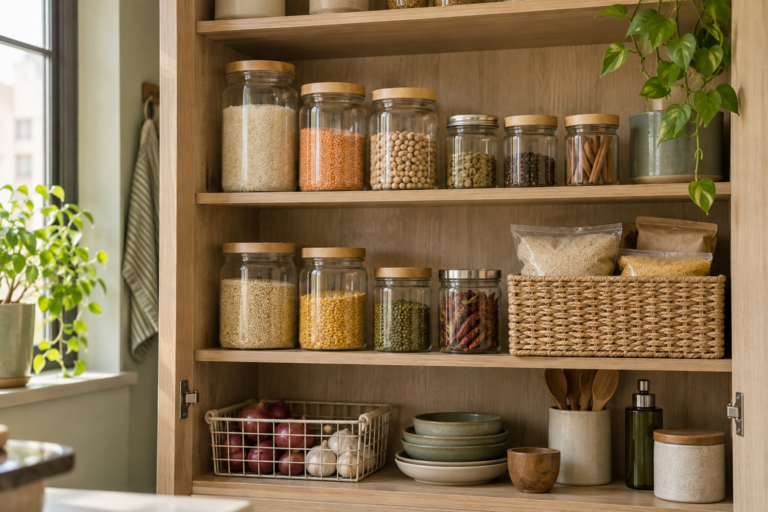
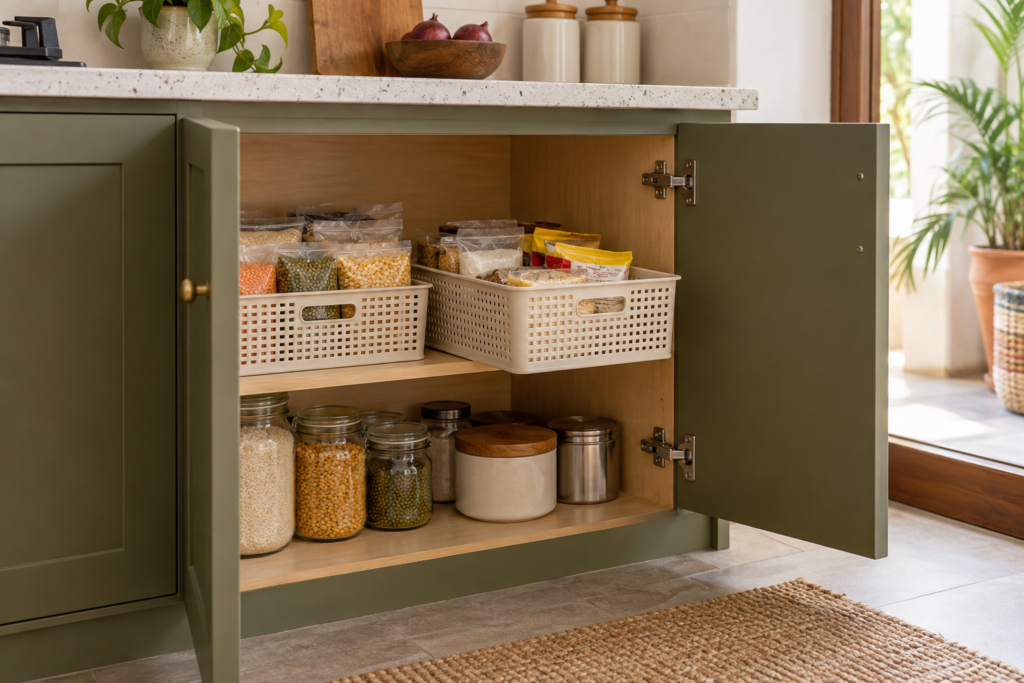
Try a labelled basket or a defined shelf section for each person's dry supplies. Put shared daily items where everyone can reach them. Keep spare packets together so the cupboard does not fill with partly hidden duplicates.
Measure baskets before buying a matching set. Equal-looking containers are not useful if one person needs space for a larger packet and another uses only a few small jars. Fair access can be achieved with different shapes.
Set a simple reset routine
- Return personal supplies to the assigned area.
- Mark a shared item when it needs replacing.
- Agree who buys the replacement before it runs out.
- Keep cleaning items in an appropriate separate location.
- Review abandoned or unidentified items together rather than silently discarding someone else's property.
Check large boxes carefully
A clear lidded box can group packets, but its lid and handles need room to move. A box that must be pulled out with both hands may be unsuitable for a high shelf. Choose a load you can handle comfortably and do not assume waterproofing from clear plastic alone.
Start with a two-week trial
Use existing baskets and labels before buying containers for everyone. After normal cooking and shopping, identify where the arrangement breaks down. Adjust the agreement or shelf allocation first; purchase organisers only for the access problems that remain.
Product formats to compare
These examples come from listing research recorded on 16 September 2026, not hands-on testing. Check the selected variant and current instructions before buying.
A useful question before you decide
Should every flatmate have an identical container?
Identical sizes are optional. Agree on fair space and access, then choose shapes that fit each person’s usual supplies. Shared items need their own agreed place and refill responsibility.
Continue planning
Editorial note: this guide distinguishes general planning advice from recorded product-listing information. No hands-on product testing is claimed. Read our editorial policy for our approach.