A useful organiser should fit both your cupboard and your routine. Before buying anything, choose one shelf or drawer and find the problem you want to solve: lost ingredients, awkward access or items that will not stay together.
1. Measure the usable space
Record the internal width, depth and height, then measure the opening past the hinges. A cupboard can be wider inside than its door opening. Include handles, pipes and shelf supports in your sketch.
For a pull-out, measure the clear space in front when it is fully extended. For a jar, leave room above its lid and enough space for your hand to grip it. Do not plan a layout that only works when every item is perfectly aligned.
2. Group by the job you do
Bring tea, coffee and their everyday utensils together. Keep cooking ingredients near the preparation area and spare packets in a separate refill group. A simple system is easier to maintain than a category for every object.
Try the groups in containers you already own. Use the kitchen for a few days and note which group is still awkward to reach. That gives a new organiser a specific job.
3. Match the organiser to the contents
| What needs organising? | Consider | Check first |
|---|---|---|
| Loose utensils | Dividers or a removable tray | Internal drawer height and longest utensil |
| Refill packets | One handled basket | Filled weight and clearance to lift it |
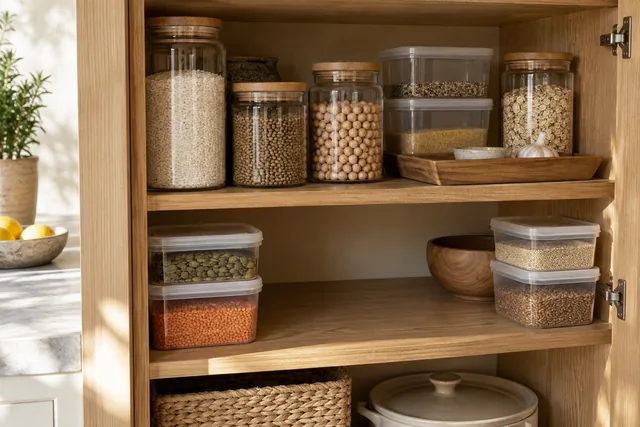
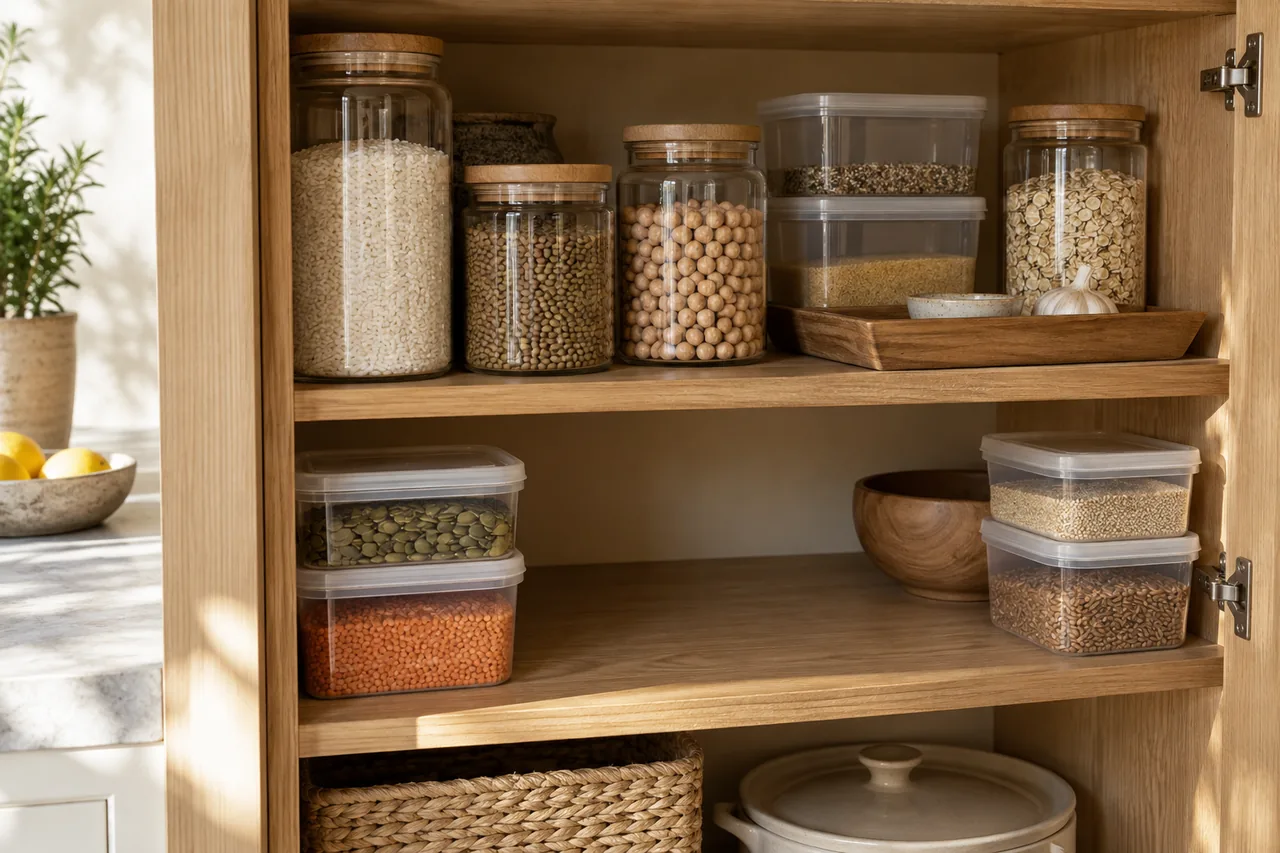
| Dry ingredients | A few appropriately sized jars | Opening, care and the pack sizes you buy |
| Hard-to-reach back shelf | A removable group or pull-out | Hinges, mounting surface and full extension |
On a small screen, scroll the table sideways to see every column.
4. Check care and everyday handling
Read instructions for the body, lid and seals separately. Do not assume dishwasher or microwave compatibility from the material alone. Check stated load limits for racks and shelves, and avoid treating an adhesive fitting as automatically damage-free.
Keep items you use daily within comfortable reach. Heavy filled jars need a position where you can grip and support them without stretching. Leave a little unfilled space for the system to change.
5. Buy for the remaining problem
Count the containers you will actually use. A large matching set can create a new storage problem if half its sizes have no purpose. Begin with the smallest change that makes the routine easier.
Common questions
Should I organise the whole kitchen at once?
Start with one troublesome shelf. A small test shows whether the grouping works before you repeat it across the kitchen.
Is advertised capacity enough to judge fit?
No. Capacity describes internal volume; it does not tell you the outer footprint, lid height or hand clearance. Compare the actual dimensions with your measurements.
Next, compare drawer dividers, baskets and bins, or plan one useful small corner.