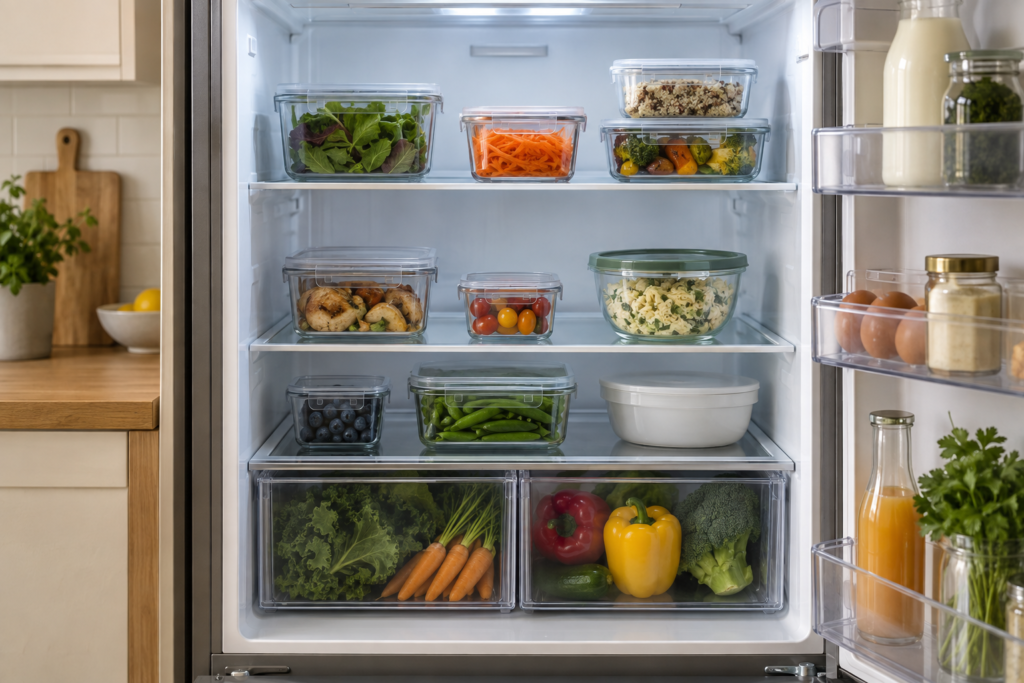
Organise fridge containers around visibility and access. Choose sizes for the portions you actually store, keep labels readable and avoid creating a deep stack that hides yesterday's food. Container organisation does not replace food-specific storage guidance.
Begin with the usable shelf space
Measure the clear height and depth without blocking vents or forcing items against the back. Check whether the door closes with the intended container in place. Include projecting clips, lid edges and handles in the footprint.
Choose a small working range instead of many unrelated shapes. Wide shallow containers can make some contents easier to see, while a compact bowl may suit a smaller portion. Judge the actual dimensions rather than relying only on the stated volume.
Keep body and lid instructions separate
The Nestasia Groovo set in our research had glass bodies and PE lids. The listing's appliance-use claims excluded the lids. This is why a general phrase such as “glass meal-prep container” is not enough to decide what can go in a freezer, dishwasher or heating appliance.
Read the manufacturer's instructions for the exact item. Do not infer leakproof transport from a close-fitting lid, or use a pantry jar for a different purpose without guidance. This article does not establish safe storage times or reheating temperatures for particular foods.
Build a simple visibility routine
- Label the contents and the preparation or storage date as appropriate.
- Preserve relevant instructions from the original food packaging.
- Place a container so its label faces you rather than the wall.
- Keep a manageable group together instead of hiding it behind unrelated items.
- Review the contents when planning meals, using food-specific safety guidance where needed.
Avoid buying before sorting
If the fridge is crowded, adding containers may use more space than the packets they replace. Start with a few items and compare the result. Keep only shapes that improve access and can be cleaned according to their instructions.
A bowl with a lid can be useful when its size suits the job, but it may occupy more shelf width than a rectangular container. Measure both before committing to a matching collection.
Product formats to compare
These examples come from listing research recorded on 16 September 2026, not hands-on testing. Check the selected variant and current instructions before buying.
A useful question before you decide
Can I use the same container for storing and heating?
Only when the exact product instructions permit both uses. Body and lid guidance can differ. Remove assumptions about appliance compatibility from the shortlist until the manufacturer confirms the intended use.
Continue planning
Editorial note: this guide distinguishes general planning advice from recorded product-listing information. No hands-on product testing is claimed. Read our editorial policy for our approach.