As an Amazon Associate I earn from qualifying purchases. Qualifying purchases through the links below may earn us a commission at no extra cost to you.
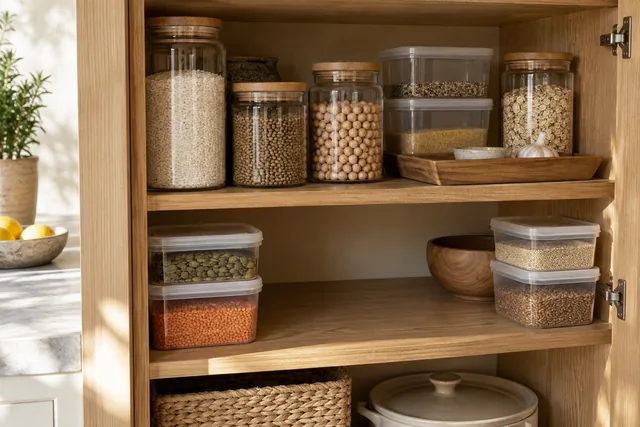
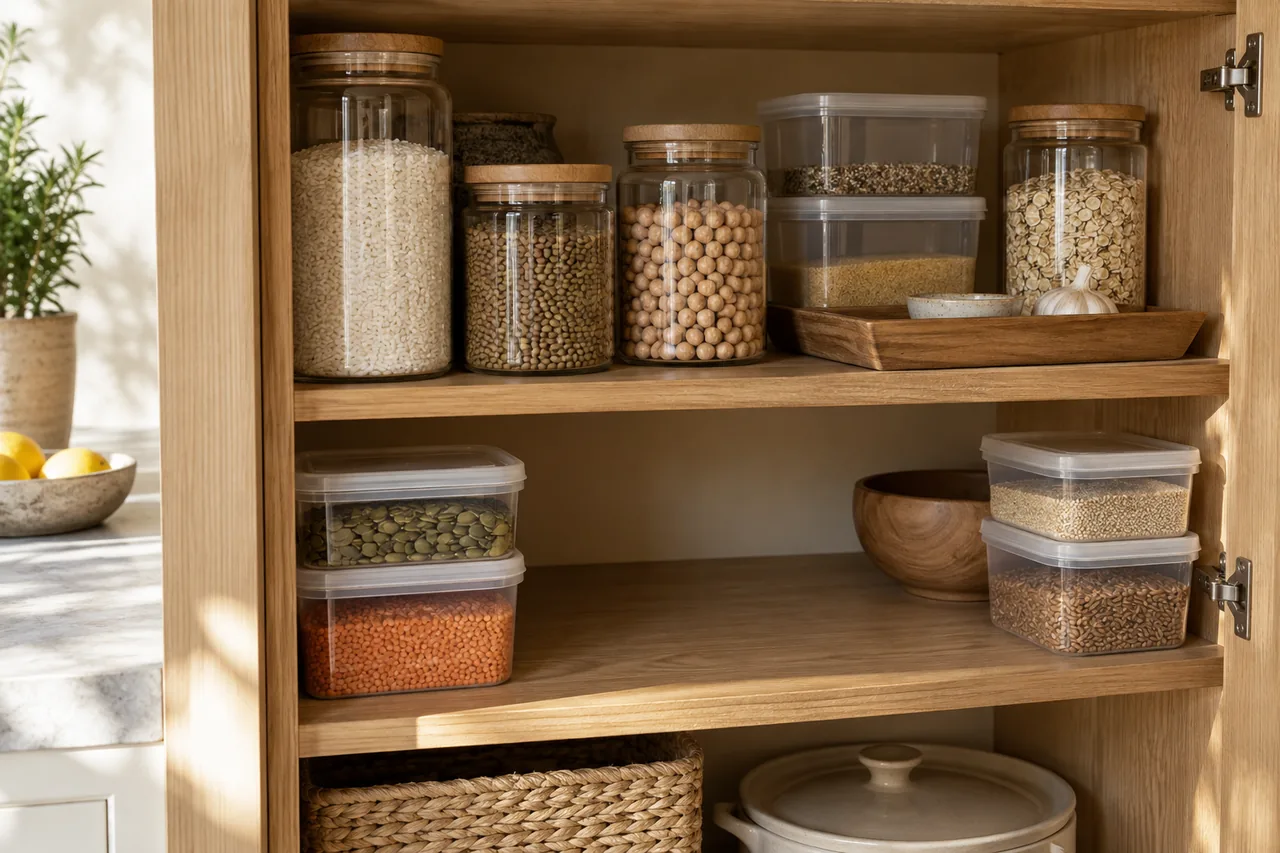
Choose pantry containers around what you store, where you lift them from and how you clean them. Glass can suit a visible shelf that you reach comfortably; lighter plastic may be easier to handle in a high cupboard. You do not need one material for the whole kitchen.
Start with the cupboard, not a matching set
Measure the usable depth, the space between shelves and the opening past the hinges. Leave room for your hand to grip a filled jar and remove its lid. A container that fits tightly on paper may be awkward to use when surrounded by other jars.
Next, list your five most-used dry ingredients. Note the pack sizes you normally buy and whether you prefer to keep the original packet inside a larger box. Container volume is measured in millilitres or litres; that does not translate directly to the same weight of rice, flour and whole spices.
Glass and plastic: compare practical trade-offs
| Decision | Glass | Plastic |
|---|---|---|
| Handling | Consider the filled weight and risk of breakage. | A lighter container may be easier to lift; check grip and lid fit. |
| Visibility | Clear sides can help you see contents. | Choose a transparent model if seeing the contents matters. |
| Care | Check instructions for both the body and lid. | Check permitted washing methods and avoid assuming heat compatibility. |
| Storage | Check that shelves can comfortably support the filled containers. | Check that stacks remain stable and lids are intended for stacking. |
On a small screen, scroll the table sideways to see every column.
The lid deserves as much attention as the body
A material label alone does not establish an airtight seal. Look at how the lid closes, whether there is a removable seal and whether every part can dry thoroughly. Do not treat an airtight marketing claim as proof that a jar is suitable for carrying liquids in a bag.
Wooden lids, plastic lids, clips and seals can have different care instructions from a glass body. A statement about a dishwasher-safe body does not automatically apply to the lid. Pantry jars should not be used for heating food unless the exact product instructions permit that use.
Two product examples to compare
The Solimo PET jar set offers a way to explore mixed sizes in a plastic set. The Better Home glass jars are an alternative to inspect if you want a small matching pair with lids. The exact closure and care instructions need checking because the listing uses inconsistent wording. These are examples of different formats, not a test-based ranking.
A practical mixed-material plan
- Keep frequently used ingredients within a comfortable reach.
- Use a small jar for an ingredient you buy in small quantities instead of leaving a large jar mostly empty.
- Keep spare packets together in a labelled basket rather than buying a second jar for every ingredient.
- Try one or two containers before replacing a working system.
- Keep the ingredient name and relevant date information when decanting from its original packaging.
When you can skip the purchase
If your current containers close properly, fit the shelf and are easy to clean, a new material is unlikely to solve a layout problem. Repositioning the jars and labelling the lids may make a bigger difference. Do not buy a complete set until you know which sizes will actually be used.
Common questions
Are all glass jars suitable for hot food?
No such assumption should be made. Check the exact manufacturer’s instructions for heat exposure, temperature changes and the lid. A dry-food storage jar is not automatically an oven or microwave container.
Should I buy containers by capacity alone?
No. Two jars with the same capacity can have different footprints and openings. Compare dimensions, lid access and filled handling as well as volume.
About this guide
This is a specification-based buying guide, not a hands-on product test. Product examples are based on listing research recorded on 20 September 2026. Check the selected variant, dimensions and current care instructions on the linked page before buying.
For more planning help, see our kitchen organiser checklist and storage selection guide.