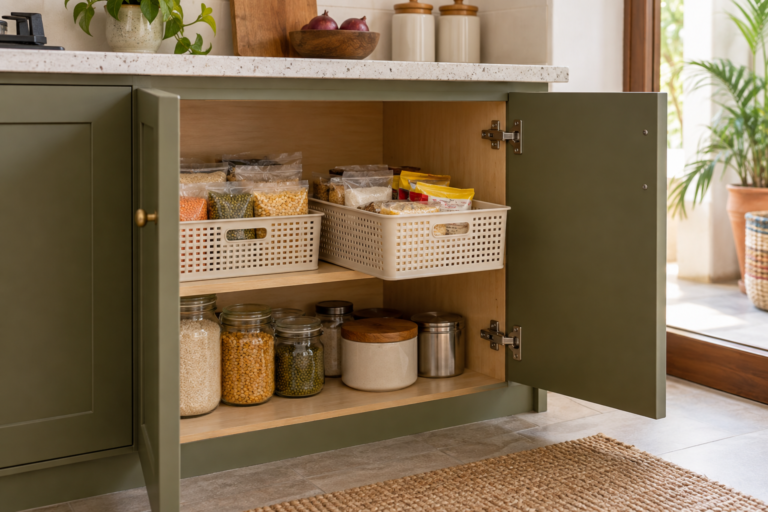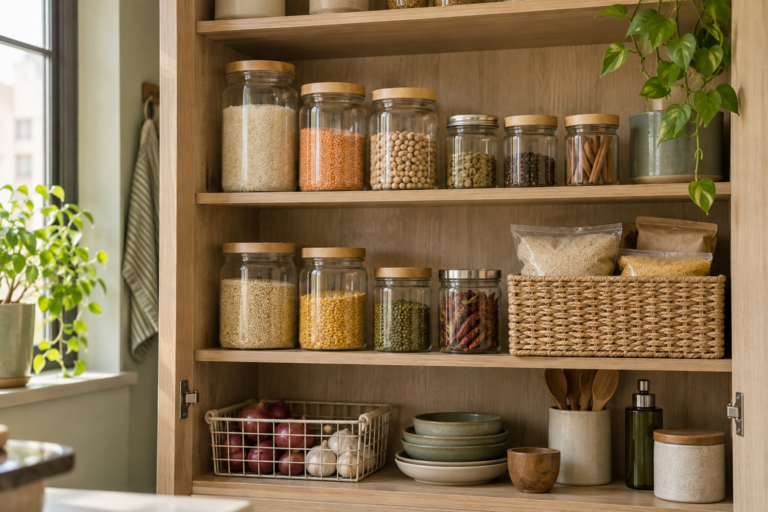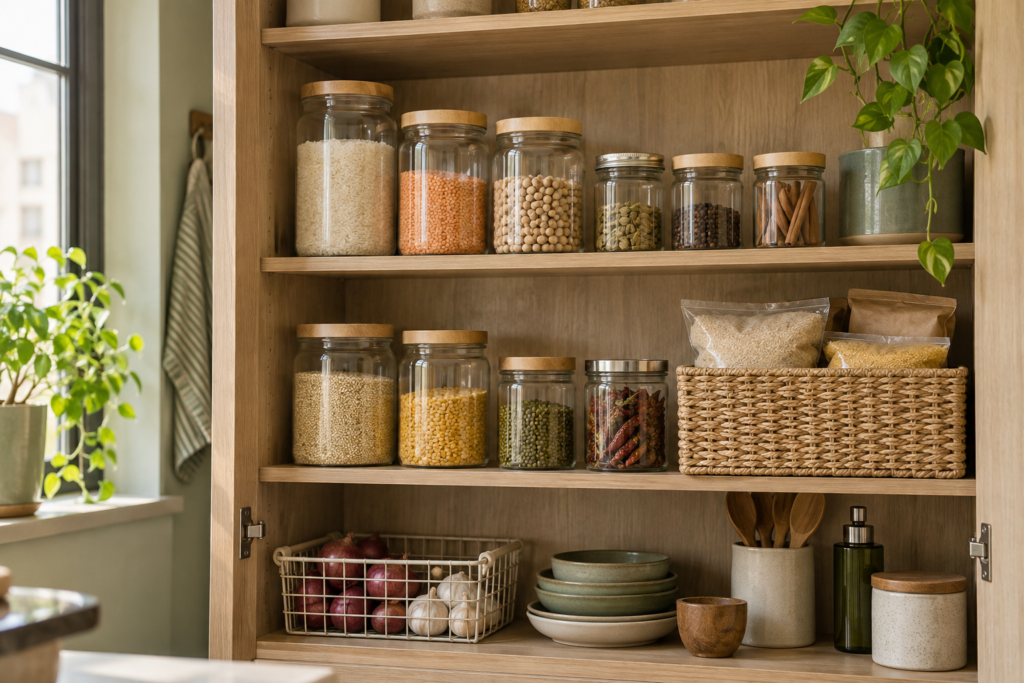
A small kitchen needs containers that make the cupboard easier to use. The best starting point is the shelf you already have: its depth, usable opening and height determine which shapes will work. Buy a small trial group before replacing every container.
Measure the usable shelf
Measure past the hinges and door frame, not only the wall-to-wall interior. Allow room for your fingers and for lifting a lid. If a shelf is above eye level, consider how you will read labels and safely handle a filled container.
Sketch the footprint of your most-used jars on paper. A row that technically fits may still be frustrating if you must remove three jars to reach the fourth. Keep daily ingredients at the front and group unopened reserve packets separately.
Compare shape, opening and quantity
- A narrow tall jar uses height but may be awkward below a low shelf.
- A wide jar can accept a scoop more easily but occupy more frontage.
- A large mixed set can provide useful variety, but only if the included sizes match your ingredients.
- A small pair lets you test handling and care before expanding the system.
Do not assume that all containers with flat lids stack securely. Check whether the exact design is intended to stack, and whether you can remove the lower jar without creating an unstable pile.
Plan the refill routine
Keep the space for washing and drying in mind. A complicated lid that is hard to clean may be an inconvenience in a compact kitchen. Follow the care instructions for the body, lid and seal separately; the material of the body does not establish appliance compatibility.
A container that needs frequent refilling is not necessarily wrong. A smaller working jar plus an organised reserve can be easier to lift than one very large vessel. What matters is whether the routine suits the way you cook.
What to buy first
Start with the two ingredients that cause the most clutter. Test their containers for a week, then add only the sizes that solved a real problem. Reuse sound containers and organise the labels before deciding that everything must match.
Product formats to compare
These examples come from listing research recorded on 16 September 2026, not hands-on testing. Check the selected variant and current instructions before buying.
A useful question before you decide
Should I replace every container with a matching set?
Only if the sizes have useful jobs. Start with the ingredients that are difficult to store; a pair or a few individual containers may solve the problem without adding unused small jars.
Continue planning
Editorial note: this guide distinguishes general planning advice from recorded product-listing information. No hands-on product testing is claimed. Read our editorial policy for our approach.