As an Amazon Associate I earn from qualifying purchases. Qualifying purchases through the links below may earn us a commission at no extra cost to you.
Organise a deep kitchen cupboard by making the back reachable. Start with front-to-back zones and removable groups, then consider a pull-out organiser only if the cupboard measurements support it. Filling the depth with more loose items usually makes access harder.
Empty one shelf and identify the obstruction
Take out the contents of one shelf, group similar items and remove anything that belongs elsewhere. The aim is to discover why the back is difficult to use: it might be a narrow door opening, a low shelf, plumbing or simply too many unrelated items.
Measure the usable opening past hinges, the internal depth and the clearance below the next shelf. Where a sliding organiser is being considered, also check the room outside the cupboard when it is extended. A door that does not open far enough can block a rack that otherwise fits inside.
Give the front and back different jobs
| Zone | Useful contents | Access method |
|---|---|---|
| Front | Daily ingredients and everyday tools | Reach without moving another group |
| Back | Spare packets or occasional supplies | One labelled removable basket |
| Low shelf | Heavier items you can lift comfortably | Stable placement with hand clearance |
| Awkward corner | A small coherent group | Leave space rather than packing it tightly |
On a small screen, scroll the table sideways to see every column.
Keep duplicates behind the open packet or in a separate refill group. Avoid hiding an ingredient behind a different category; otherwise you may buy another packet simply because you cannot see the first one.
When a pull-out rack can help
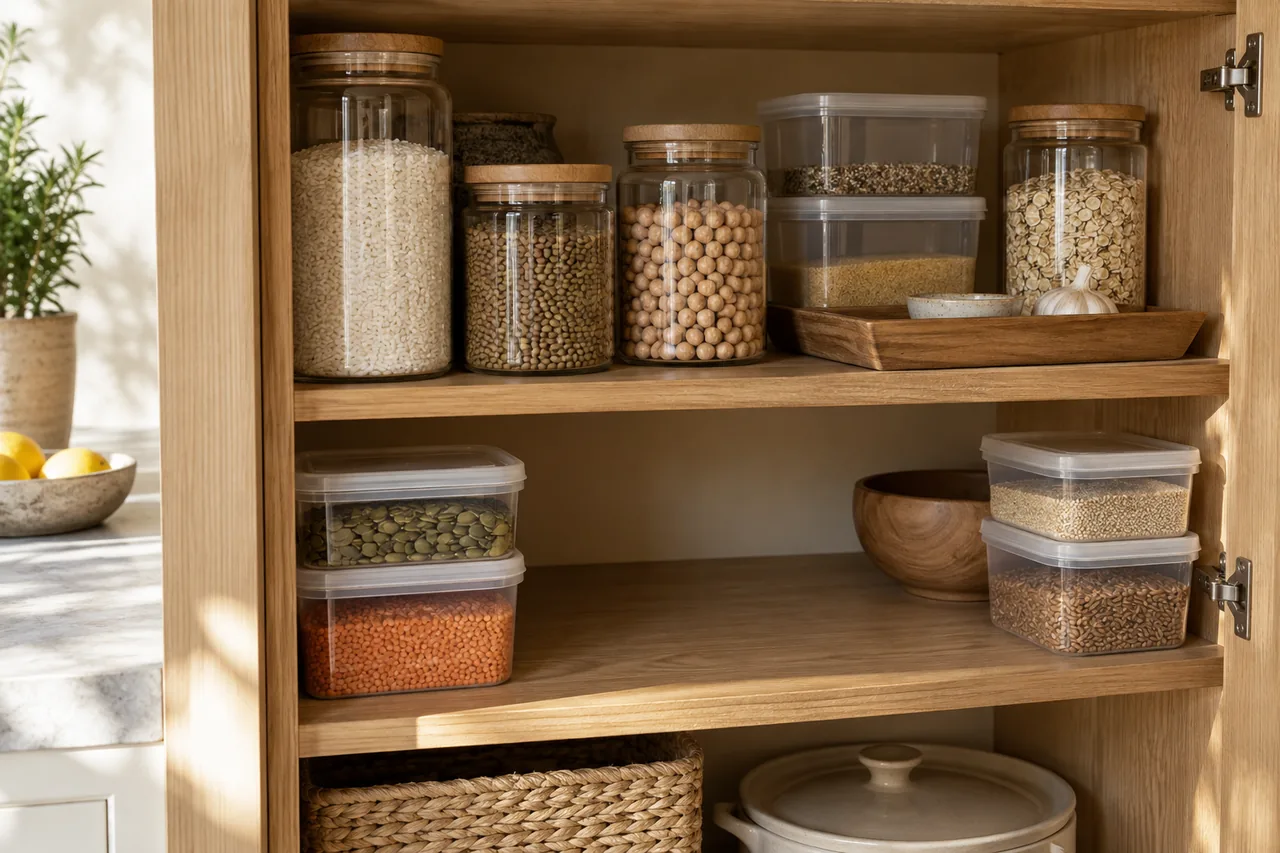
A pull-out rack may help when it brings a useful group forward through a clear opening. It is less suitable if pipes interrupt its footprint, the door obstructs the slides or the organiser makes the remaining shelf space too narrow to use.
The ABJA example researched for this guide is a metal sliding organiser with adhesive installation. Check the current dimensions, compatible mounting surface and stated load limit before choosing it. We have not tested its adhesive or weight capacity, and do not describe it as damage-free.
Try a removable basket before adding hardware
Use a basket you already own to gather baking supplies, spare tea or refill packets. Test whether you can pull it forward with one hand while supporting it securely. A basket that is too wide or heavy creates a new access problem.
For jars, labels on the top can help when you look down into a low cupboard. Front labels work better at eye level. If you change containers, choose sizes around the ingredients rather than trying to fill every centimetre of the shelf.
A ten-minute reset routine
- Return each group to its assigned zone.
- Move the item being used to the accessible position.
- Check for forgotten duplicate packets at the back.
- Remove anything that prevents the door or organiser from moving freely.
- Leave enough space to lift one item without unloading the shelf.
When not to buy an organiser
If the shelf is overloaded with items you rarely use, reducing that load should come first. A rack cannot fix unsuitable shelf spacing or an obstructed door. Test your new grouping for a few days before buying anything, and purchase for the measured problem that remains.
Should every shelf have a pull-out?
No. A shallow shelf or a cupboard holding a few large items may already be easy to use. Add a moving organiser only where it improves a specific access problem.
About this guide
This is a specification-based buying guide, not a hands-on product test. Product examples are based on listing research recorded on 20 September 2026. Check the selected variant, dimensions and current care instructions on the linked page before buying.
For more planning help, see our kitchen organiser checklist and storage selection guide.