Choose the system around the contents, rather than buying a matching set first. Dividers separate small items in a drawer, baskets keep a group together and bins can make deep shelves easier to use. Each solves a different access problem.
Start with what keeps getting lost
Empty one drawer or shelf. Group items by how you use them and remove anything that belongs elsewhere. Note whether the problem is mixed categories, hidden contents or a pile that collapses when you remove one item.
Compare the three formats
| Format | Useful for | Main trade-off |
|---|---|---|
| Drawer dividers | Small items that need separate spaces | Fixed compartments may waste space around long tools |
| Open baskets | Frequently used groups and larger loose items | Contents remain exposed; handles add to the footprint |
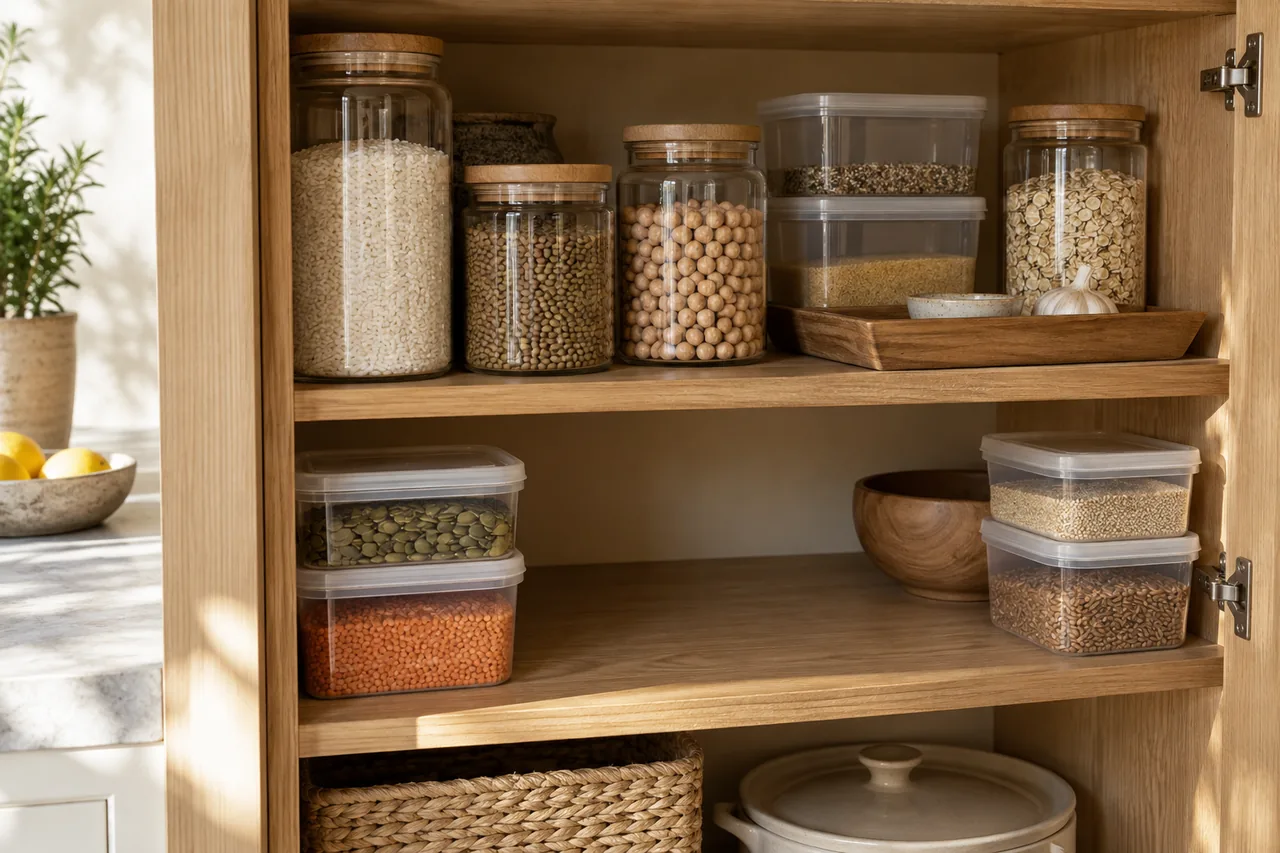
| Clear bins | Visible groups on deep shelves | A full bin may be heavy; lids add another step |
On a small screen, scroll the table sideways to see every column.
Measure for removal, not just storage
Measure the narrowest opening, not only the shelf behind it. A basket needs enough overhead room to grip its handles. A drawer tray needs clearance when the drawer closes, including any utensil sticking above the divider.
If you intend to stack bins, check that the exact design supports stacking and that removing a lower bin is manageable. A tall stack can make frequently used items harder to reach.
Choose materials around the location
A dry wardrobe and a cleaning cupboard have different needs. Read care instructions before choosing woven, fabric or plastic storage. Check that the container can be cleaned and dried in the way you intend to use it.
Store cleaning products according to their labels and keep their original identifying information. Do not mix them into food-storage groups simply because the containers match.
Make the system easy to reset
Use plain, outward-facing labels when several people share the space. A short label such as “refills” or “baking” is easier to maintain than a complicated sorting scheme. Keep one small area unfilled for changing needs.
Common questions
Do all the containers need to match?
No. Consistent labels and sensible group sizes can make different containers easy to use. Replace working storage only when a new format fixes a specific problem.
Should every bin have a lid?
A lid can suit occasional storage but adds a step each time you need something. For a daily-use group in a clean, dry cupboard, an open container may be more convenient.
For a kitchen project, use the five-minute organiser checklist. For a cramped corner, start with our small-space guide.